Introduction
This article starts a series of features. The occasion is the 80th anniversary of the end of World War II (1945–2025) and the commemoration of October 28. The aim is to show how the inaction and appeasement of European powers led to the greatest disaster in world history. From Hitler’s rise to power in 1933 to the invasion of Poland in 1939, Europe was slowly moving toward a war everyone feared but no one prevented.
You can read my previous article here.
Hitler’s First Steps in the Chancellery
When Adolf Hitler became Chancellor of Germany on January 30, 1933, he began pursuing his strategic goals. A few days later, on February 3, he informed his generals of his ultimate aim: to conquer territories in Eastern Europe and Germanize them. He ordered immediate preparations for expansion. Despite the Treaty of Versailles, which prohibited tanks, Germany found ways to act. A secret agreement with the Soviet Union in 1923 allowed Germany to develop armored vehicles. New mechanized warfare tactics were tested there.
Young, active German officers, like Heinz Guderian, studied British military theories and thinkers, including Basil Liddell Hart and Colonel John Fuller. They even observed exercises conducted by the British in the 1920s in the Salzburg plains. From this, they developed the concept of fast-moving units combining tanks, artillery, and infantry. These units could penetrate deeply into enemy territory. Hitler embraced these ideas. He planned an army including three Panzer divisions.
The new air force, the Luftwaffe, led by ace pilot Hermann Göring, was already laying the groundwork for expansion. During the period of prohibition, Germany maintained its aviation skills by producing civilian planes. Aeroclubs provided trained pilots. In March 1935, Hitler revealed the Luftwaffe and announced the army’s expansion to 300,000 men. Mandatory military service was reinstated. Britain and France protested cautiously about violating Versailles but soon began rearming slowly.
Hitler occupies Austria
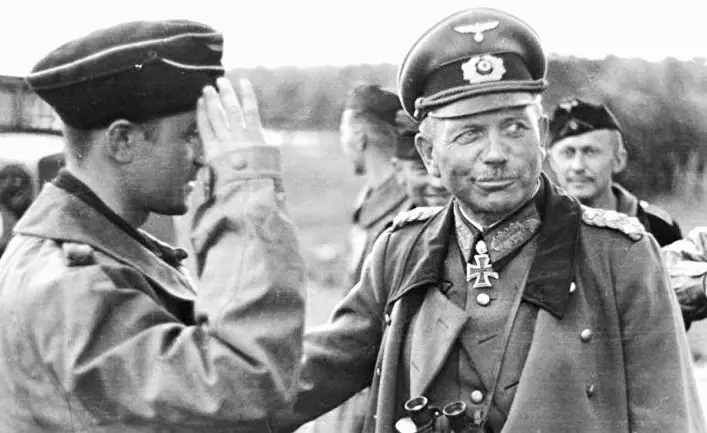
Up to this point, Hitler appeared relatively moderate. He had only regained territories within Germany, like the Rhineland and Saarland. But now, he aimed for an ambitious plan: Austria. In 1934, Austrian Nazis tried to seize power and merge Austria with Germany. Austrians spoke German, though Austria had never been part of Germany.
In February 1938, another Nazi conspiracy emerged. Austrian Chancellor Kurt Schuschnigg protested to Hitler. Hitler demanded Austria stop oppressing Austrian Nazis and proceed with unification. Schuschnigg announced a referendum for Austrians to decide on independence.
However, on March 12, 1938, the day before the referendum, Hitler sent German troops into Austria, fearing a negative outcome. The sudden move, combined with the warm welcome from Nazi supporters, led to a bloodless takeover. Within hours, Hitler announced Austria’s annexation into the Third Reich. An independent state became part of greater Germany. Western democracies responded with cautious reactions and took no action.
Hitler’s Attack on Czechoslovakia
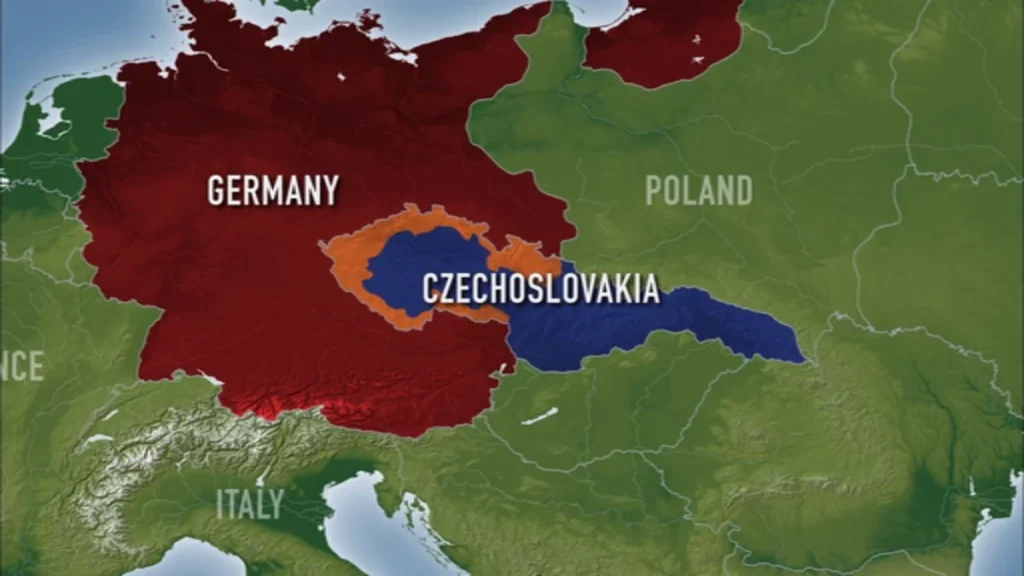
In the summer of 1938, Hitler targeted the next victim: Czechoslovakia. In the northwest was the Sudetenland, home to a large German minority. The Sudeten Germans were descendants of the Austro-Hungarian Empire. They had been separated from it after Czechoslovakia’s creation in 1919. This caused a national wound, a ticking time bomb from the Treaty of Versailles.
Hitler exploited tensions, supporting Sudeten demands for autonomy and threatening Prague with invasion if ignored. The Czechoslovak government resisted. It ordered general mobilization and prepared to defend. Its army was numerous and well-equipped. Strong fortifications along the German border forced Hitler to retreat temporarily.
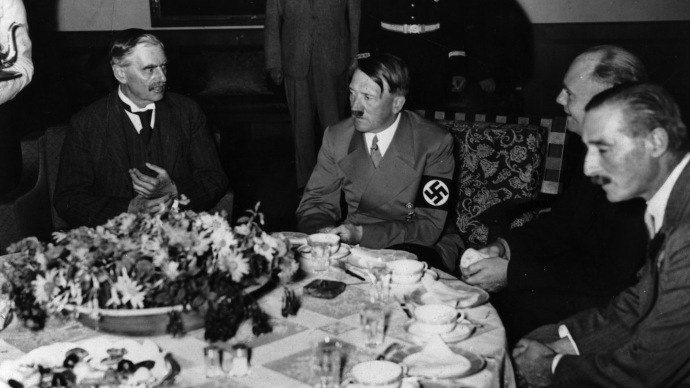
Meanwhile, Europe watched anxiously. British Prime Minister Neville Chamberlain, wanting to avoid another war, took the initiative to mediate. He met Hitler twice, who assured him that if allowed to annex the Sudetenland, he would not claim more territory.
On September 29, 1938, Germany, Britain, France, and Italy signed the Munich Agreement. Mussolini acted as mediator. The Sudetenland went to Germany. Hitler promised “peace in our time.” Chamberlain returned triumphantly to London, holding the agreement as a peace symbol. A few days later, on October 1, German troops entered the Sudetenland, capturing border fortifications without resistance.
Preparation for the Invasion of Poland
Hitler then turned to his next strategic goal: Poland. He again cited a German minority cut off by the Treaty of Versailles as a pretext. He demanded the return of the port city of Danzig to connect East Prussia with the rest of Germany. The Poles refused. Hitler had to wait, not yet ready for a multi-front war, while matters with Czechoslovakia were still open.
In March 1939, Slovakia, part of eastern Czechoslovakia, sought more autonomy. Hitler invited Slovak Prime Minister Emil Hácha to Berlin and forced him to place the country under German protection. German troops occupied the rest of Czechoslovakia with little resistance. Most of the country joined the Reich. Slovakia became a protectorate. For the first time, Hitler seized non-German-speaking areas. Britain and France responded only with weak protests. No one blocked his actions.
By late March, Hitler renewed his Danzig demand. This time, France and Britain warned that they would declare war if Germany attacked. Hitler remained confident. He believed Western powers would avoid military confrontation, seeing them as weak and hesitant.
Molotov–Ribbentrop Pact
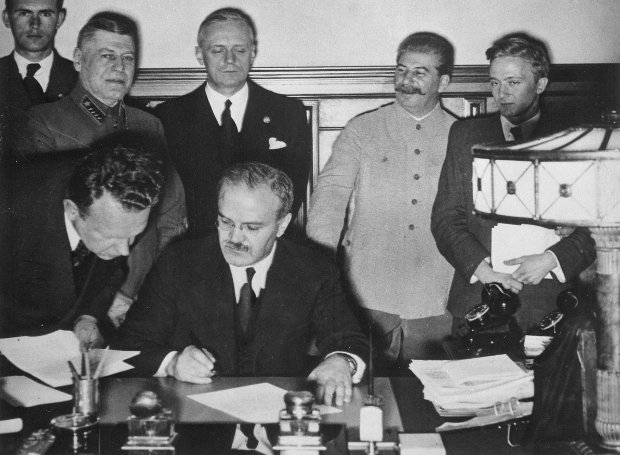
In the Soviet Union, Stalin worried about Germany’s growing aggression. In April, he proposed an alliance with Britain and France, but talks failed. Disappointed, Stalin concluded there was no other option to counter Germany. On August 23, the USSR and Germany—longtime mortal enemies—signed a Non-Aggression Pact. Its secret protocol divided Poland between them. Stalin could also take the Baltic states: Estonia, Latvia, and Lithuania. Freed from Soviet interference, Hitler ordered German forces to prepare for invasion.
The Invasion of Poland
On the night of August 31, the German Wehrmacht completed preparations for the upcoming attack. Hitler had made the decision that would plunge the world into war. That afternoon, German forces made their final moves before the invasion. Aircrews checked targets, and Panzer units took their assigned positions.
In the early hours of September 1, German troops, disguised in Polish uniforms, attacked a German station along the border, leaving few dead. Hitler used this incident to justify his attack. At 8 a.m., before an official declaration of war, Germans crossed the Polish border. Mechanized units advanced into the country. Two days later, on September 3, Britain and France declared war, fulfilling their pledge to support Poland. However, the Poles were already in an extremely difficult situation.
Blitzkrieg
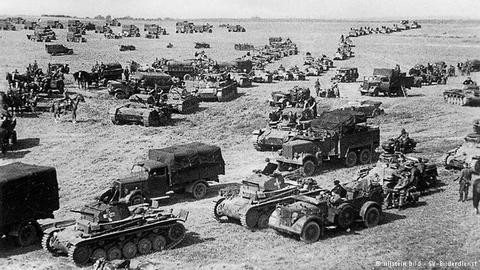
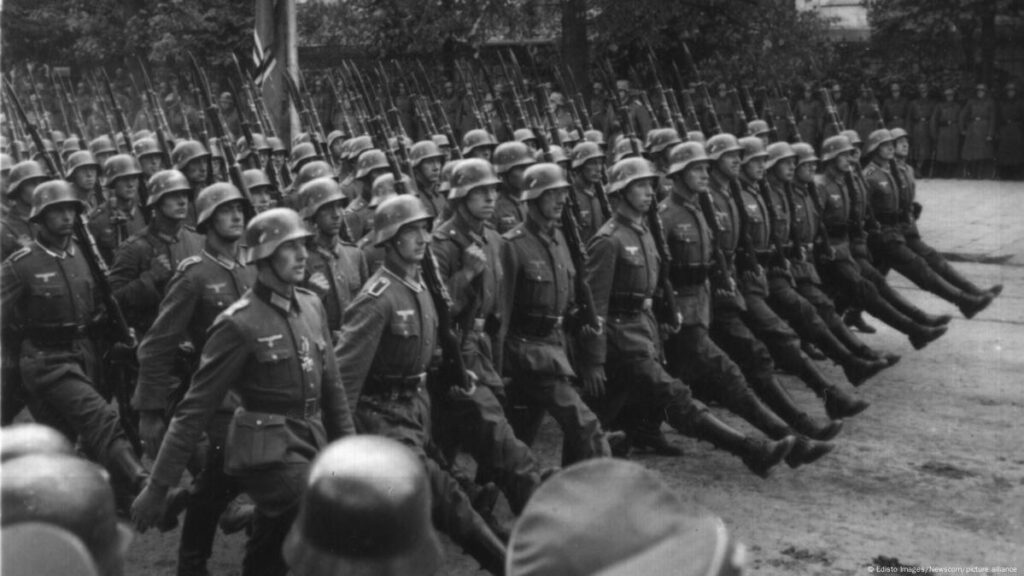
The Poles faced not only numerical inferiority but a new type of warfare: Blitzkrieg, or lightning war. In 1939, the German army numbered about 1.5 million men. Its core was the Panzer divisions: six armored divisions and four light divisions for reconnaissance, totaling 2,400 tanks. Their goal was to break enemy defenses and penetrate deeply into hostile territory, cutting communication and causing chaos. Infantry followed to handle remaining fortifications.
The Luftwaffe, Germany’s new air force, was designed for Blitzkrieg. It had 2,500 aircraft against the Poles. The most famous was the Junkers Ju-87 Stuka dive bomber, acting as “flying artillery” with precise attacks supporting fast-moving ground units. The Poles had only 600 aircraft, mostly outdated and less technologically advanced. On land, their army had 500,000 men, 800 tanks, and 11 cavalry brigades armed with lances and horses, facing armored units.
German Army Superiority
Germany’s advantage was not just numerical. Panzer II tanks were used innovatively as independent units with heavy firepower. Polish tanks were dispersed to support infantry. The situation worsened after Czechoslovakia’s conquest. Western Poland, including Warsaw, was now surrounded on three sides by German territory. This strategic advantage was crucial for Germany’s grand plans. Initial Panzer attacks aimed to break Polish lines. Coordinated moves were planned to encircle and crush the enemy.
These operations were assigned to the Army Group North under Fedor von Bock, launching two main attacks from northeast Germany and East Prussia. Simultaneously, Army Group South, under Gerd von Rundstedt, started two attacks from Silesia and Slovakia, aiming to close the main resistance centers near Warsaw and Brest-Litovsk.
In the first days, German forces advanced successfully. The Polish air force was quickly neutralized, leaving the skies to the Germans. Panzers penetrated deep into Poland, while Stukas and medium bombers proved effective, supporting ground attacks. Polish forces, although resisting, scattered into small pockets and many soldiers were captured. Cavalry units valiantly tried to stop the German tanks, but the speed and maneuvers of the Panzers made success impossible. By September 8, internal German armies had joined, and troops were already approaching Warsaw’s outskirts. On September 17, the outer armies met at Brest-Litovsk, completing the encirclement.
The Soviet Invasion of Poland
On the same day, Soviet forces entered eastern Poland, using the non-aggression pact with Hitler. The Polish army dispersed chaotically, and the government fled abroad. Despite the confusion, Warsaw resisted. Defenders refused to surrender, drawing Luftwaffe and artillery fire toward the city. Hitler closely monitored the campaign. On September 27, Warsaw was forced to surrender. The next day, Germany and the USSR partitioned Poland according to their agreement. The Soviets annexed most of the eastern territory.
Consequences of the Invasion
Germany took the remaining Polish territory. Both regimes began eliminating anyone considered a future threat. Many were arrested or executed, showing the violent treatment Eastern Europeans would face. Nazis considered them inferior. SS units collected Jews. Many were forced to live in ghettos under miserable conditions, while others were executed on the spot.
Despite losses, the Polish army was not entirely defeated. Over 50,000 soldiers escaped and regrouped in France. A temporary government under General Władysław Sikorski was formed there. From abroad, Poles continued to fight bravely for their country’s liberation.
In the next part, we will examine Germany’s invasion of France in 1940, which reshaped the continent. We will see how Blitzkrieg, tested successfully in Poland, proved devastating in Western Europe. Allied forces, despite their actions, could not stop Hitler