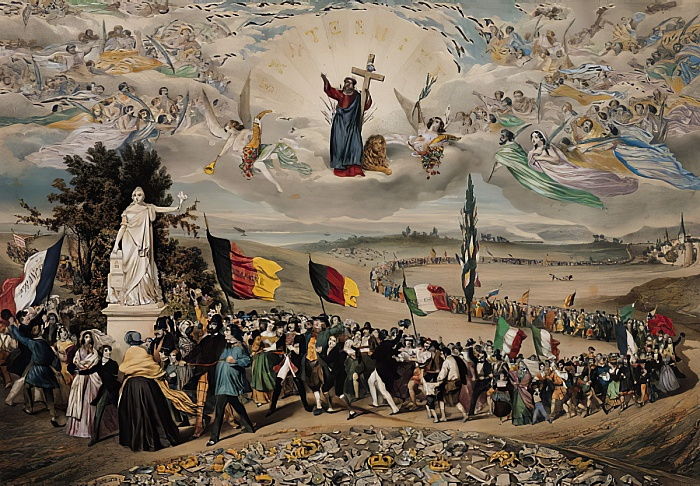
Nationalism is one of the primary political ideologies that emerged during the historical period of modernity. It connected nation-states with international relations and the political organization of society. The concept of the nation-state first appeared during the French Revolution of 1789, while the Industrial Revolution and the social changes of the 19th century further reinforced the importance of national self-determination and independence—an emphasis that continued into the 20th century.
What is Nationalism and What is Modernity?
Nationalism is defined as the tendency of nations—a group of people who identify with each other through shared historical experiences, culture, language, or common myths—to form states. This formation aims to foster development and provide protection against the challenges of international relations. Modernity, on the other hand, is a historical period starting from the 17th century, as defined by Giddens. It marks a sharp break from the past, the emergence of modern institutions, rapid developments across technological, scientific, social, and ideological fields, and the profound transformations that ensued.
Nationalism is deeply intertwined with modernity and the evolution of contemporary political organization. At the onset of modernity, the nation became the central political actor, replacing older forms of political and social organization—especially as absolutist regimes declined. Changes in the economy, society, and technology forged new types of social relationships and political consciousness. Nationalism emerged as a unifying mechanism, shaping the state around national identity. It developed alongside the rise of the modern state, the spread of secularization, and the ascent of new forms of political organization and participation such as national parliaments and political parties.
As a political ideology, nationalism articulated modernity’s demands by linking the formation of the nation-state to the needs of a new era. It highlighted the tension between traditional communities and modern national structures (i.e., the state).
Nationalism and the Nation-State
The spread of nationalism during modernity is closely tied to the rise of the nation-state, the unification of fragmented states, the construction of shared national identities, and the recognition of national rights. While the French Revolution symbolically marks the starting point, these dynamics played out more fully in the 19th century. Nationalism championed national self-determination and independence. Nation-states rose as primary actors in political life, challenging imperial power structures—especially after WWII, where the USA and the USSR led the push for national self-determination.
The state evolved into the vessel of national sovereignty and cultural unity. The consolidation of the nation-state became a cornerstone of modernity, while nationalism cultivated a sense of pride, identity, and collective consciousness.
For example, the unification of Germany in 1871 under Otto von Bismarck exemplifies nationalism’s role in state-building. Through strategic wars, Prussia defeated Austria and France, leading to the recognition of the German people as a single national entity and strengthening the state as a means of fulfilling national ambitions. In the 20th century, nationalism remained central to political developments. The collapse of empires such as the Austro-Hungarian and Ottoman after WWI further validated the nation-state model. Similarly, anti-colonial struggles in the Middle East, Africa, and Asia after WWII carried strong nationalist demands for self-determination.
Nationalism and Social Relations
Nationalism influenced not only state structures but also social relations. Amidst the industrial and urban transformations of modernity, social groups sought political integration and participation. Theorist Benedict Anderson, in his book Imagined Communities, emphasizes that nations are socially constructed entities. Promoting national identity within the nation-state served to unite diverse groups under a common identity.
The bourgeoisie often supported nationalism as a pathway to democratization and economic progress. Meanwhile, although the working class sometimes embraced internationalist ideologies, it often aligned with nationalism during crises—such as World War I. However, nationalism also fueled the marginalization of minorities, as seen in the ethnic cleansing policies of the 20th century.
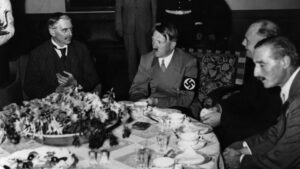
For example, the Hungarian Revolution of 1848 and the subsequent recognition of Hungary’s national independence demonstrated how various social groups—from workers to the middle class—integrated into the national identity. Conversely, nationalism also sparked brutal outcomes, such as the persecution and genocide of Jews during the Holocaust orchestrated by Nazi Germany in WWII.
Nationalism and International Relations
Nationalism has profoundly shaped international relations, acting as both a driver of war and a tool of diplomacy. It has influenced the global balance of power and dictated how states interact. Nationalist rivalries fueled conflicts and crises, most notably World War I, which stemmed in part from nationalist tensions and demands for self-determination. The war’s aftermath saw empires dismantled and new national states emerge.
Nationalism can thus trigger national conflicts and heighten tensions in international relations, as competing nations pursue dominance or the defense of their interests. A clear example is World War I, where competition for national supremacy and territorial expansion led to cascading conflicts across the globe. The Treaty of Versailles in 1919, which ended the war, enshrined the principle of national self-determination, as advocated by Woodrow Wilson, and redrew Europe’s borders by creating new states.
Conclusion
In summary, nationalism was a fundamental force in shaping the modern world. As a dimension of modernity, it redefined the relationship between state and society, reorganized international relations, and influenced social dynamics. While it served as a tool for liberation, it often transformed into a mechanism of oppression. Nevertheless, nationalism remains a foundational principle in political and social organization.
Sources
Notes and slides from Professor Konstantinos Lavdas’ lectures in “Political Analysis”
Smith, A.D. (2013). Nationalism and Modernism. Routledge
Kissinger, H. (2010). Diplomacy. Vancouver: Crane Library at The University of British Columbia
Anderson, Benedict. Imagined Communities: Reflections on the Origin and Spread of Nationalism. London, Verso, 2016
Hague, Rod & Harrop, Martin. Comparative Government and Politics (3rd Edition)—especially for definitions of nation