The following article closely examines the phenomenon of electoral absenteeism in Western Democracies. It presents the possible reasons for its existence as well as the different forms it takes within the context of state entities and political systems. Although voting is considered a fundamental right and primary means of participation in modern democracies, electoral absenteeism is a fact. We believe the social and political implications of this particular phenomenon to be of utmost importance- not only within the Greek state but also across Europe and the rest of the world.
Right to Vote
The right to vote is undoubtedly one of the most important characteristics of modern democracies. In modern times, direct democracy is rarely encountered. The constant differentiation and evolution of political processes in contemporary states around the world has led to a period in which a significant and noteworthy phenomenon is observed: electoral absenteeism.
This refers to the growing tendency of voters to refrain from participating in elections, despite having a constitutional right to vote. In doing so, they transform their individual choice into a collective effort to convey a message to those in power. This phenomenon is observed in many countries around the world and has diverse and complex dimensions at its roots. Behind electoral absenteeism lie social pathologies, concerns and crises, factors that require thorough analysis in order to pave the way toward their understanding and, ultimately, resolution.
The history of voters’ rights
Athenian Democracy
Around 508/7 BCE, the first form of voting appeared in Ancient Athens under Cleisthenes, in the form of negative voting- ostracism. This process allowed Athenian male citizens to vote for the man they believed deserved exile. While in modern times exile is associated with authoritarian regimes, in Ancient Athens, it was the cornerstone of Democracy.
Within the framework of Athenian democracy, the decision to ostracise belonged to the people- The “Demos” (Δήμος)- and not the rulers. If someone received more than 6,000 votes, the individual with the highest number was exiled. If no one reached the threshold, no one was exiled. This form of voting does not resemble modern democratic voting, particularly due to its direct and negative character. Nevertheless, it represents the first expression of the people’s participation in public affairs- matters that had previously been exclusively under the authority of a monarch or leader.
τὸ ἐναντιούμενον τῷ δυναστεύοντι δῆμος ὠνόμασται – Θουκυδίδης Ιστορίαι [6.89.4]
“The people who oppose the ruler are called the demos.”
From Cleisthenes to today…
The Athenian Democracy of Cleisthenes constituted a significant turning point in the political history not only of Ancient Greece, but of the world in general. It provided the impetus toward democracy (thus, the right to vote), which went through many (not only) evolutionary phases in order to become the system of government we know today. After its journey through the Roman Republic, the Middle Ages and the Renaissance, the sovereignty of the people has taken a central role in modern democratic political systems and is expressed primarily through the citizens’ right to vote.
After many centuries of development of the democratic system, it evolved to the point where a parliamentary republic was established in the Greek state as the form of Government, as defined by the Constitution, which states that the people exercise power for the people.
Article 1 of the Greek Constitution
- The form of government of Greece is that of a parliamentary republic.
- Popular sovereignty is the foundation of government.
- All powers derive from the People and exist for the
People and the Nation; they shall be exercised as specified
by the Constitution
Despite the institutional guarantee of public participation in political processes through elections and the right to vote, the phenomenon of electoral absenteeism is commonly observed. In Greece, absenteeism has been increasingly observed over the past decades. In the parliamentary elections of May 2023, voter turnout reached 38.33%, compared to 42.22% in 2019 and 36.06% in 2015. These figures reveal a significant level of voter disengagement from elections, a fact that raises questions regarding its underlying causes.
Electoral Absenteeism: Possible Causes and Different Interpretations
Low voter turnout can be interpreted through different lenses and in various ways, potentially leading to different conclusions and solutions. In this article, the focus is brought to some of these interpretations.
Satisfaction
Electoral absenteeism could be seen as an acceptance of the existing political situation. A central question here is: Why should one vote when everything is going well? Indeed, if a citizen feels no dissatisfaction with the government or the regime, then abstaining from the ballot may be considered a sign of approval. Satisfaction may lead to a lack of action- if everything is fine, there is no need to take action to change it.
Disappointment and Distrust
Although satisfaction and acceptance of daily life as it is-without feeling the need to participate in elections-are possible, more common are other causes that lead to absenteeism. Disappointment and lack of trust in the political system and political parties often result in abstention from electoral processes. The chronic issues of the political system-such as corruption and scandals, lack of transparency in decision-making, democratic deficit, career politicians, and the sidelining of popular sovereignty-lead to deep distrust among citizens toward the political system and its workings.
Alternative Forms of Political Participation
Another interpretation of electoral abstention is political participation through alternative means. Citizens may choose what they consider to be more effective ways to express their political opinions. Abstention from elections does not necessarily indicate acceptance or dissatisfaction with political parties or the government, but rather dissatisfaction with the electoral process itself, which is viewed as insufficient.
An extension of this explanation is the possibility that the electoral process is not considered critical. Specifically, elections may be seen as standardised and institutionalised events. For this reason, voters might not perceive the issues decided through elections as crucial, since they have been asked to vote before and know they will be asked again in the future, as it is a constitutionally guaranteed right.
Electoral Absenteeism around the World
Electoral abstention is certainly not limited to Greece. It is increasingly observed in many countries around the world. Some examples include Lithuania (58.96% abstention in 2024), Albania (53.68% in 2021), Switzerland (53.36% in 2023), and Cyprus (34.28% in 2021), among others. Decreased voter participation is a challenge for democracy globally.
The rate of voter participation varies significantly among democratic states, ranging from above 85% to 55% or lower, such as in Portugal, France, and Switzerland. These percentages refer to those who are registered to vote. In some countries, voter registration happens automatically, while in others, it may be a time-consuming process.
Right to Vote and Electoral Abstention: United States of America
A Brief History of Voting Rights in the U.S. and the Struggle for Equality
Suffrage – the right of citizens to vote (derived from the Latin word suffragium)
1700s;
The U.S. Constitution granted states the authority to determine voting rights independently. Generally, in the 18th century, despite belief in democratic values, voting rights were restricted to white male landowners. In some U.S. states, only confirmed Christians were allowed to vote.
1800s;
In 1828, for the first time, all white men had the right to vote in the majority of states. However, women and Black people were excluded. In 1866, Black men were granted the right to vote in Wisconsin. In 1877, the Fifteenth Amendment to the U.S. Constitution declared that voting rights could not be denied based on race or colour.
1900s;
Women gradually gained voting rights in certain U.S. states, including Washington, California, Arizona, Kansas, Oregon, Alaska, Illinois, Nevada, Montana, Arkansas, Rhode Island, Texas, and South Dakota. At the same time, Indigenous Americans and Black citizens (initially and primarily men) also gained the right to vote in some states, albeit at a slower pace.
Today, in the United States of America, after long struggles for equality and the securing of civil rights, the right to vote is held by Indigenous peoples, Black citizens, and women. However, this does not mark the end of the struggle for equality, nor should it lead to complacency or satisfaction within American society.
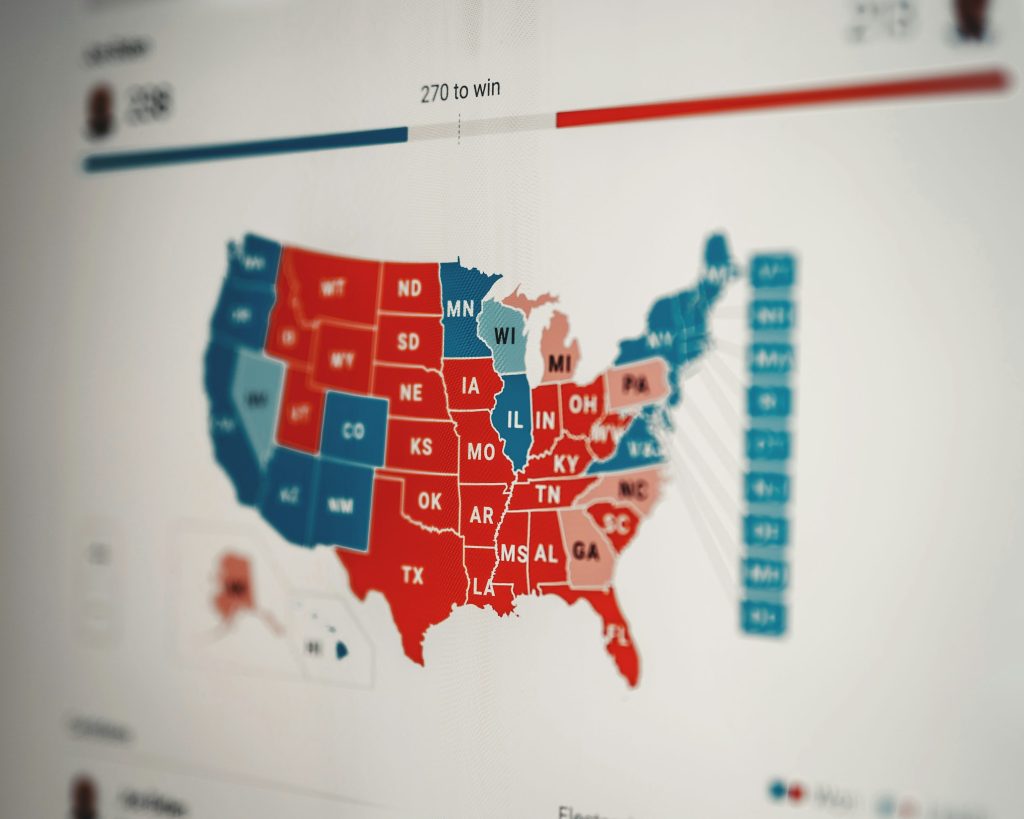
The Unique Electoral System of the U.S.
Regarding the political system of the United States, beyond its distinct features (Electoral College, Governors, Senate, House of Representatives, Vice President, etc.), the voter registration process is particularly noteworthy. This involves citizens registering on the electoral rolls before the presidential elections. The process has been widely criticised as time-consuming and difficult by many voters. At least 1 in 4 American citizens has not completed the registration process.
Electoral Abstention in the U.S.
Voter turnout: the number of citizens who cast a valid ballot, expressed either as a percentage of those who have the right to vote or those who are registered to vote.
In the U.S., electoral abstention is a fact, just like in the aforementioned countries, and it represents a major issue as it raises the question of how accurately the people’s will is truly represented in elections. Specifically, voter turnout in the U.S. has decreased by 35 percentage points over the past few decades. In the 2020 presidential elections, approximately 81 million eligible voters did not go to the polls. In the same election, the highest abstention rates were recorded in the states of Oklahoma, Arkansas, Tennessee, and Virginia, with turnout between 54.99% and 60%.
In addition to the previously mentioned causes and interpretations of low voter turnout, two more factors specific to the U.S. electoral system deserve attention: administrative barriers and the complexity of the political system.
Administrative Barriers
The voting process may include significant bureaucratic obstacles that discourage citizens from participating. In many cases, voters must register in advance — something that is not required in all countries — and some states impose strict limitations. Additionally, the lack of a national holiday on election day makes it particularly difficult for working citizens to vote, leading to higher rates of abstention.
Complexity of the Electoral System
The U.S. electoral system is complex and difficult for voters to understand, resulting in confusion. This complexity, and the confusion it causes, can lead younger or less-informed voters to abstain from participating altogether.
Conclusion
The right to vote is, if not the most important, certainly one of the most crucial elements of democracy. It connects popular sovereignty with the decision-making process and the political system. Despite long-standing struggles to secure voting rights, electoral abstention remains a widespread phenomenon in many countries. Addressing low voter turnout is essential, as voting is not only a constitutionally protected right but also a responsibility toward the future of democracy.
Sources
https://www.duvalelections.com/General-Information/Learn-About-Elections/History-Of-Elections
https://www.greeceinfigures.com/eklogiki-symmetoxi
https://www.greek-language.gr/digitalResources/ancient_greek/library/browse.html?text_id=73&page=214
https://ekloges-prev.singularlogic.eu/2019/v/home/index.html\
https://worldpopulationreview.com/country-rankings/voter-turnout-by-country#title
https://www.carnegie.org/our-work/article/voting-rights-timeline
Newton, K. & van Deth, J.W., 2020. Comparative politics. Edited by G. Konstantinidis and S. Blavoukos. Thessaloniki: Tziolas Publications. [In Greek].
Hague, R., Harrop, M. & McCormick, J., 3rd ed. Comparative politics and governance. Translated by G. Christidis. Edited by G. Pagoulatos and I. Papageorgiou. Athens: Kritiki Publications. [In Greek].
Featured Image by Arnaud Jaegers on Unsplash