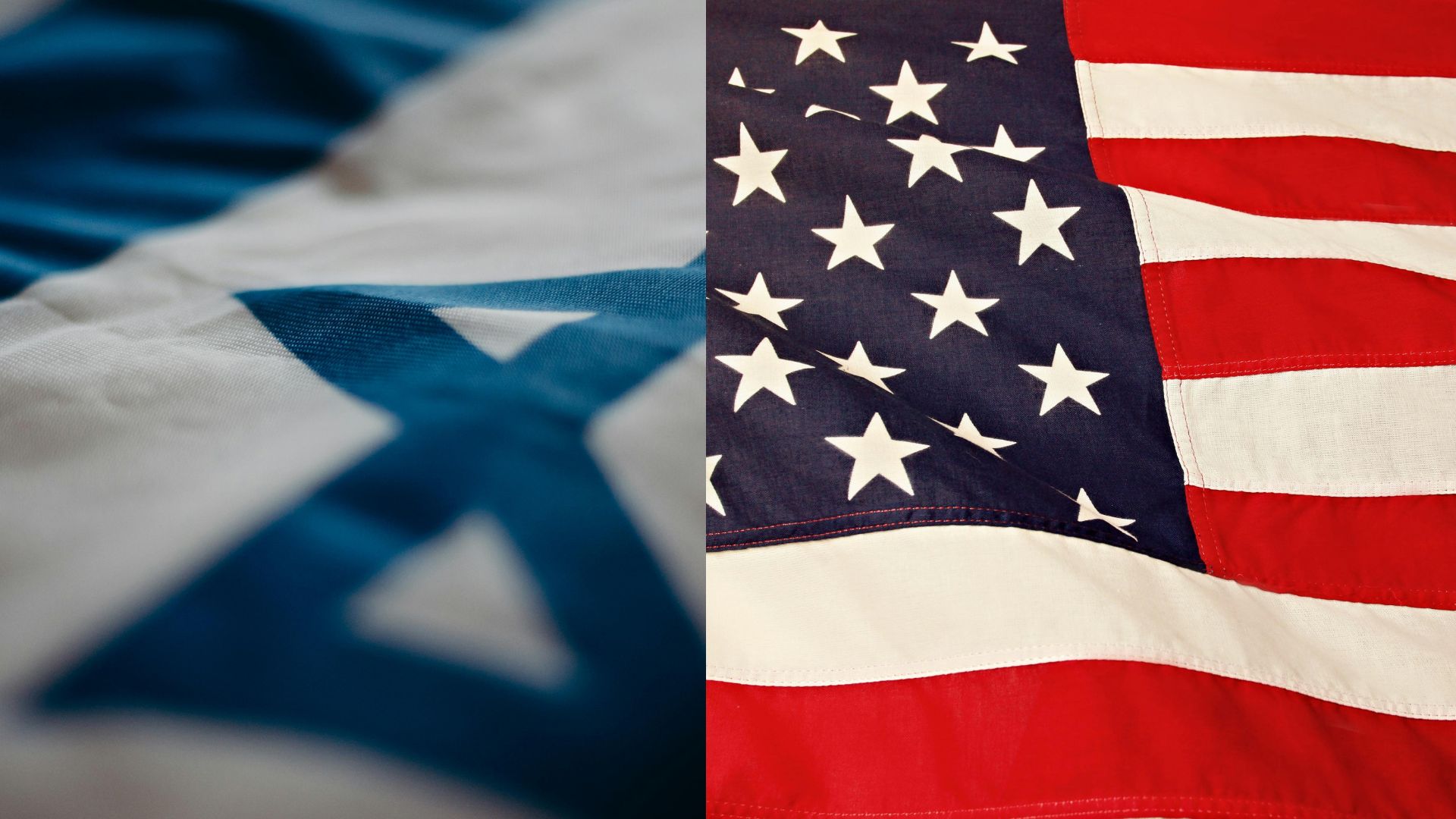
The relationship between the United States of America and Israel is one of the most pressing issues in international politics and a timeless subject of public debate. In an era of shifting power balance, this bond functions as a stable axis within the global system.
Why does the US-Israel relationship matter?
The US-Israel relationship has once again come to the forefront of international attention following the events of October 7th 2023, when Hamas carried out a terrorist attack on Israel. Israel’s response (an extensive military campaign in Gaza) set the Middle East in jeopardy and brought the world’s attention to the region. At the same time, it reignited discussion about the US’s long-standing and unwavering support for Israel.
The profound significance of this support lies in the historical evolution and nature of the cooperation between the two nations.
The US-Israel partnership is not merely a strategic alliance. Rather, it is a relationship built on historical, cultural, and ideological foundations that deeply shape the Middle East’s future as well as global security.
A walk through History: From the Balfour Declaration to the Founding of Israel
This relationship is often thought to have begun in 1948, the year the State of Israel was founded. In reality, however, its roots reach further back to the rise of the Zionist movement in the 19th century. The Zionist movement laid the groundwork for the creation of a Jewish state and its eventual tightening of relations with the West.
In 1917, the Balfour Declaration expressed support for the establishment of a national home for the Jewish people in Palestine, marking the first diplomatic recognition of the idea of a Jewish state.
A few months later, US President Woodrow Wilson publicly endorsed the Declaration, confirming that Washington shared the vision of an independent Jewish state in the Middle East that would secure the safety of the Jewish people.
This was neither a coincidence nor an isolated gesture. It reflected the spirit of an era in which Zionist ideas resonated far beyond Jewish communities.
Zionism and the Origins of the Jewish State
The cornerstone of Israel’s creation was Zionism—an ideology and political movement chiefly inspired by Theodor Herzl (1860–1904). Herzl, a 19th-century journalist, argued that the only way to ensure the survival of the Jewish people was through the establishment of a sovereign state that would unite all Jews of the diaspora.
Zionism outside Jewish Borders
Herzl’s idea found support not only among Jews but also among Christian Evangelicals, especially in Britain and later in the United States. According to Evangelical Christian Zionism, the founding of a Jewish state was a natural fulfilment of the biblical prophecy of the Jews’ return to the “Promised Land.” In this way, the existing link between American religious thought and the vision of a Jewish homeland grew even stronger.
From the Holocaust to Israel
Undeniably, global public opinion shifted dramatically after the horrors of World War II and the Holocaust. Deep compassion and moral sensitivity emerged worldwide in response to the extermination of millions of Jews by the Nazi regime.
The United States, now the leading power of the West, combined moral restoration with its strategic interests.
In 1948, several years after negotiations and the failure of the two-state plan (the creation of a Jewish and an Arab state), the State of Israel was declared on May 14, with Chaim Weizmann as President and David Ben-Gurion as Prime Minister.
Just minutes after Israel declared independence, the United States, under President Harry Truman, officially recognised the new state. This act was not merely diplomatic; it was symbolic, marking the beginning of an alliance that would shape future geopolitical developments.
USA-Israel Cooperation
The formal consolidation of this multidimensional relationship occurred in 1962. In August of that year, President John F. Kennedy, after numerous Israeli requests, agreed to sell Hawk anti-missile systems to Israel. This was the first U.S. military support deal with Israel.
A few years later, in 1967, Israel’s victory in the Six-Day War confirmed the importance of American military and technological assistance.
Meanwhile, the Soviet Union was supporting Arab states (mainly Egypt, Syria, and Jordan) with weapons and political backing.
Thus, the Middle East was divided into two camps: those aligned with the West and those supporting the Soviet Union. Within this confrontation, Israel became an outpost of American influence.
The 1990s: A New Era
A new phase in bilateral relations emerged in the 1990s. With the collapse of the Soviet Union, the United States rose as the sole global hegemon and took on the role of mediator in the long-standing Arab-Israeli conflict.
The Oslo Accords
The Oslo Agreements of 1993 marked a historic attempt at peace between Israel and the Palestinian Authority. This initiative, under President Bill Clinton, highlighted the U.S. role not only as an ally but also as a guarantor of regional stability.
“Blank Cheque”
The ongoing financial and military assistance that the U.S. provides to Israel reflects a decades-long strategy, often referred to as a “blank cheque”: unconditional and unchecked support.
Undoubtedly, the over $3 billion in aid the U.S. grants to Israel has faced criticism. The international community often questions this support, viewing it as an obstacle to peace efforts in the Middle East.
Shared Values between USA-Israel
The enduring resilience of the U.S.–Israel relationship cannot be explained solely through strategy. It rests on a set of shared values and narratives that act as its ideological glue.
Democracy
Both countries define themselves as democracies born from the pursuit of freedom and self-determination.
The United States is seen as the beacon of democracy in the West, while Israel is often described as “the only democracy in the Middle East.” This shared identity carries symbolic significance.
Furthermore, both nations view themselves as defenders of certain core values in a hostile environment. They see their mission as protecting freedom, justice, and faith.
USA-Israel: a Relationship of mutual benefit
Beyond shared values and ideology, the U.S.–Israel relationship remains one of mutual benefit; each side has something essential to gain.
For Israel, American support (economic and military) is a matter of survival and security. Military know-how, access to advanced weapons systems, and diplomatic backing provide priceless advantages.
For the United States, Israel serves as a valuable partner in a region where direct intervention might otherwise be viewed as neo-colonial. Washington maintains influence in the Middle East and can shape geopolitical developments without direct involvement.
Thus, this relationship operates as a win–win partnership: Israel enjoys security and legitimacy, while the U.S. secures a reliable strategic foothold in the heart of an unstable region.
International Reactions
American support is not without cost. It has often provoked criticism both domestically and internationally. Critics argue that Washington’s close alignment with Israel undermines its credibility as a neutral mediator in the Middle East.
The unconditional “blank cheque” policy has triggered backlash from Arab states that view the U.S. as a biased power.
Despite tensions and strong reactions, this strategic alliance has never truly been shaken.
October 7th and the current situation
The events of October 7, 2023, served as a dramatic reminder that the Middle East remains volatile and unpredictable. The Hamas attack and Israel’s subsequent response revived the question of the limits of American support.
Despite calls for restraint, the United States reiterated and once again confirmed its unwavering commitment to Israel’s security. President Joe Biden stated that “Israel has the right to defend itself,” a phrase consistently repeated by every U.S. administration, regardless of political party.
Thus, the relationship transcends partisan divides. For the American political establishment, supporting Israel is not merely a party stance-it is almost a national obligation.
Conclusion: The Alliance That Defines the Century
The U.S.–Israel relationship is more than a strategic partnership. It is a bond that unites two nations through shared narratives, mutual interests, and enduring ties.
From the Balfour Declaration and Herzl’s vision to the Oslo Accords and the events of the 21st century, this connection has proven remarkably resilient.
Despite its stability, the Middle East remains volatile, and as long as global peace and balance depend on the West, the U.S.–Israel relationship will continue to stand as one of the most critical chapters in international politics.
Bibliography
https://www.britannica.com/biography/Theodor-Herzl
https://www.britannica.com/event/Balfour-Declaration
https://www.parapraxismagazine.com/articles/evangelical-zionism
https://www.parapraxismagazine.com/articles/evangelical-zionism
https://www.kathimerini.gr/world/449654/i-idrysi-toy-kratoys-toy-israil
https://open.library.ubc.ca/media/stream/pdf/52966/1.0076013/3
https://history.state.gov/milestones/1993-2000/oslo
https://www.reuters.com/world/biden-criticizes-extremist-settlers-west-bank-2023-10-25