Law of the Sea: Historical Background, Hugo Grotius
The need for legislative action in the field of maritime activities was clearly expressed as early as the 17th century. Hugo Grotius, a Dutch humanist, jurist, and diplomat, is considered the father of International Law even four centuries later. His work Mare Liberum [The Free Sea] forms the basis upon which this title has been bestowed upon him.
Mare Liberum – Hugo Grotius
In the book Mare Liberum, published in 1609, the idea that the sea belongs to everyone and its use for commercial purposes must be free appeared for the first time. According to the Dutch author, the sea bears a greater resemblance to air than to land, a fact that justifies its “free” status. The central idea of the book is summarised by the vastness of the sea, which is cited as the reason Grotius believed that the sea cannot belong exclusively to anyone. Ultimately, Hugo Grotius’s idea prevailed at the time because naval powers needed unhindered access to the seas.
Law of the Sea: United Nations Convention on the Law of the Sea [UNCLOS]
The United Nations Convention on the Law of the Sea was signed in 1982 in Montego Bay to limit and codify the previously accepted status of the “freedom of the seas,” and it entered into force in 1994. It constitutes the most fundamental legal text defining binding activities at sea, and 168 countries worldwide have acceded to it.
The sea is a space of activities, resources, and interests. The Convention on the Law of the Sea sets rules for activities conducted at sea. It defines what is permitted in each zone: Territorial Sea, Contiguous Zone, Continental Shelf, and Exclusive Economic Zone (EEZ). Each term paves the way for rights and obligations. Therefore, UNCLOS forms the foundation of balance between states in a world where power and competition play a leading role.
A central point of UNCLOS is the Territorial Sea [territorial waters]. Article 3 of the Convention states that every state has the right to establish the breadth of its territorial sea up to a limit of 12 nautical miles. This zone is essentially an extension of land territory, and the respective state holds corresponding rights within these 12 nautical miles.
Territorial Waters / Territorial Sea
Territorial waters constitute one of the most important maritime zones of a state. According to Article 3 of UNCLOS, every state has the right to determine the breadth of its territorial waters up to 12 nautical miles from its baselines. When we speak of the territorial sea, we are not referring to something theoretical, but to the actual limits of state sovereignty.
The concept of territorial waters, as enshrined in UNCLOS, does not remain merely a theoretical legal tool. In practice, the way each state chooses to exercise its right to determine the extent of its territorial waters is influenced by geography, international relations, and the balance of power in the region. In the case of Greece, this issue acquires particular significance, as it is directly linked to the geopolitical reality of the Aegean and the Eastern Mediterranean.
The Maritime Regime in Greece Today
As a contracting party to UNCLOS, Greece has the right to set its territorial waters up to 12 nautical miles.
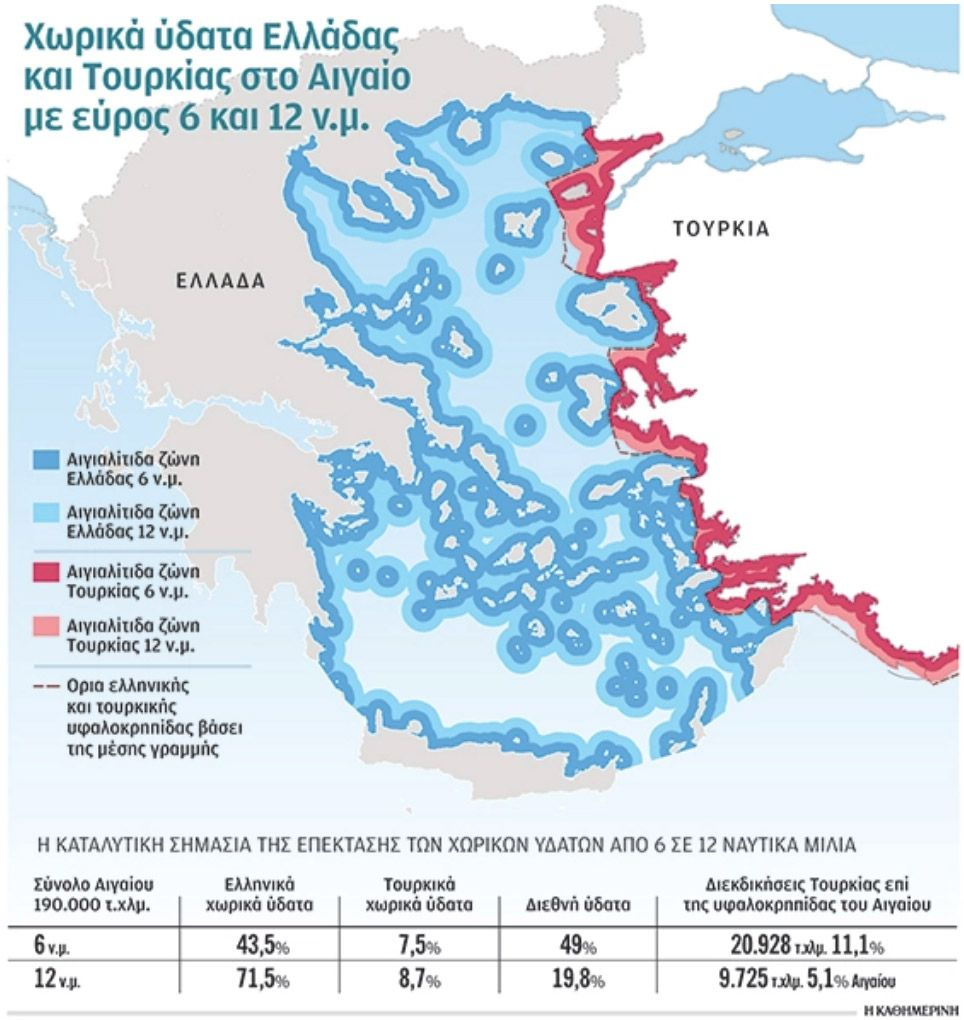
However, today Greece maintains its territorial waters at 6 miles (note: the Greek text mentions 5 miles in one part, but standard practice is 6) and, along with Albania, Montenegro, and Kuwait, has not declared jurisdictional zones beyond territorial waters. Setting territorial waters at 12 n.m. is a move that most states have already made. The Convention on the Law of the Sea does not provide for the granting of “special maritime corridors” or exceptions to the 12-nautical-mile right.
Examining the current situation, we find that Greece’s territorial waters regime is not uniform everywhere. Specifically, in the Aegean, the breadth of the Territorial Sea remains at 6 n.m. However, since 2021, Greece has taken a significant step: it extended its territorial waters to 12 n.m. in the Ionian Sea, down to Cape Tainaron. This decision was made within a legislative framework based on the rights defined by the Convention on the Law of the Sea.
Greek-Turkish Conflict
The issue of territorial waters is not just a segment of the Law of the Sea or a legal concept; it is the central point of contention between Greece and Turkey in the Aegean region.
The conflict lies in the differing perceptions of the Law of the Sea by the two states. The Greek side considers the extension of its territorial waters as a legally established right of every state under UNCLOS. In contrast, Turkey views the Greek approach as something that would significantly affect the balance of navigation and strategy in the Aegean.
[Η ΚΑΘΗΜΕΡΙΝΗ]
Thus, gradually, a purely legal issue began to take on the dimensions of a political and geopolitical matter, leading to one of the most characteristic and pressing confrontations between the two countries.
Casus Belli
At this point, the confrontation exceeds the limits of differing interpretations and enters a phase of crisis and pressure. Notable is the decision of the Grand National Assembly of Turkey, which stipulates that a potential extension of the territorial sea [12 n.m.] of the Greek islands would constitute a cause for war (casus belli). Consequently, from that point on, this issue has been at the forefront of security and international law concerns as a potential disruption to the balance in the Mediterranean.
This is not a formal state of war, nor a typical legal act of International Law. It is a constant political warning that the extension of Greek territorial waters will trigger a reaction from the Turkish side as an act of war. The casus belli is a clear message to its recipient, Greece, with the explicit aim of influencing the country’s future moves. The paradox lies exactly here: A legally established right of states, utilized by almost all nations on the planet, simultaneously constitutes a cause for war for Greece and is treated as a provocation that must be averted. Thus, this issue remains constantly at the heart of Greek-Turkish relations.
International Law
The casus belli is perhaps the most characteristic and yet problematic element of the Greek-Turkish confrontation. The term refers to Turkey’s position that the extension of Greek territorial waters will be considered a reason for war. The issue of Greece’s 12 nautical miles is part of a broader environment of tension. The casus belli remains like a gray cloud overshadowing every effort at normalization. At the same time, relations between the two countries seem to move in a state of inertia: neither de-escalation nor open conflict.
From the perspective of International Law, the problem is the legality of the casus belli. According to the Charter of the United Nations, the international system is based on a fundamental principle: specifically, the principle that states must refrain from the use of force in their international relations. Meanwhile, the Law of the Sea clearly recognizes the right to extend the territorial sea to 12 nautical miles without exceptions.
If the threat of war can function as a mechanism to prevent the implementation of a rule of International Law, then the legal framework is weakened in its entirety.
Consequently, the paramount question hanging over the above situation is: Does this constitute a precedent for the violation of the rules of International Law and their interpretation according to respective state interests?
Sources
https://www.un.org/depts/los/convention_agreements/texts/unclos/unclos_e.pdf
https://www.britannica.com/biography/Hugo-Grotius
https://eur-lex.europa.eu/legal-content/EL/TXT/PDF/?uri=CELEX:21998A0623(01)
https://trade.ec.europa.eu/access-to-markets/el/glossary/horika-ydata