The following article delves into an in-depth analysis and examination of the role of U.S.-
Mexico bilateral agreements, the immigration situation, the conditions in detention centers, and the international
silence, aiming to shed light on how diplomacy operates not always as a guarantor, but
often as a “laundromat of violations.”
Diplomacy and Rights
Migration at the United States–Mexico border has been, for decades, one of the most thorny
issues on the American political stage. Prompted by geographic proximity, economic
inequality, political crises, and lack of security in Latin America, thousands of people
attempt to cross the border into the U.S. each year in search of a better future. However, the
way the U.S. has handled these migratory flows has raised serious concerns about the
violation of human rights. This gives rise to a critical question: how does
diplomacy—especially through bilateral agreements and diplomatic mechanisms—cover up
or even legitimize the infringement of fundamental human rights?
The Nature of U.S.-Mexico Bilateral Agreements
Diplomatic cooperation between the U.S. and Mexico on migration is not a new
phenomenon. From the early 20th century to today, the two countries have signed a
multitude of agreements aimed at managing migration flows, securing borders, and
fostering economic cooperation. A telling example is the 2019 agreement in which Mexico
agreed to deploy 6,000 National Guard troops to its southern border in order to stem the
flow of migrants from Central America, in exchange for avoiding economic sanctions from
the U.S. This agreement, made under the threat of tariffs by then-President Trump, stood as
a classic example of “coercive diplomacy,” where the “partner” is forced to adopt policing
policies without genuine negotiation.
Similarly, the “Remain in Mexico” policy (Migrant Protection Protocols), implemented in
2019 and reinstated in 2021, required asylum seekers to remain in Mexico until their cases
were heard by U.S. courts. As a result, thousands of people—including women and
children—were left stranded in Mexican border cities under deplorable and dangerous
conditions, exposed to trafficking networks, violence, exploitation, and murder.
Notably, the “Remain in Mexico” policy was heavily criticized by human rights organizations
and struck down by courts as inhumane. Yet, its maintenance through bilateral negotiations
and its framing as a cooperative effort rendered it “diplomatically acceptable.”
Conditions in Migrant Detention Centers: From Violation to Normalization
Over the past few decades, U.S. immigration policy has shifted from a concept of reception
to one of deterrence. This is most clearly manifested in the existence and operation of
dozens of migrant detention centers along the southern border. These centers are managed either by state agencies or private corporations (such as GEO Group and CoreCivic), with an
emphasis on financial gain and lacking adequate transparency.
Hundreds of reports have documented inhumane conditions in these facilities.
Overcrowded cells with limited oxygen, lack of access to basic health services, allegations of
physical abuse and sexual harassment, and the separation of children from their parents—a
practice that reached tragic proportions under the Trump administration (over 5,000
children were removed from their parents, with no reunification plan in place).
This situation is no secret. On the contrary, it is well-documented by NGOs like Amnesty
International, Human Rights Watch, and the ACLU. However, the diplomatic pretext of
“national security” and the U.S.’s insistence on portraying itself as a “sovereign state that
controls its borders” has allowed these policies to persist without meaningful international
intervention.
Moreover, the U.S.’s decision to label asylum seekers as “illegal invaders” rather than as
victims or rights-bearing individuals contributes to their stigmatization and
dehumanization.
International Indifference: Inertia or Hypocrisy?
The international community—particularly through the UN, the UN High Commissioner for
Refugees (UNHCR), and human rights organizations—has repeatedly condemned U.S.
border policies. However, such criticism rarely comes with sanctions, practical pressure, or
globalized solutions. On the contrary, the U.S. retains its status as a superpower with
strategic and economic clout, which grants it a kind of “diplomatic immunity.”
Reports are recorded, but policies do not change. In reality, many Latin American
countries—those that directly bear the consequences of migrant returns—are forced to
cooperate, as they are economically and diplomatically dependent on Washington.
This creates a paradox of diplomatic ethics: how can the international community impose
sanctions on smaller countries for human rights violations, while remaining a spectator—or
even a collaborator—when the same violations are committed by the U.S.?
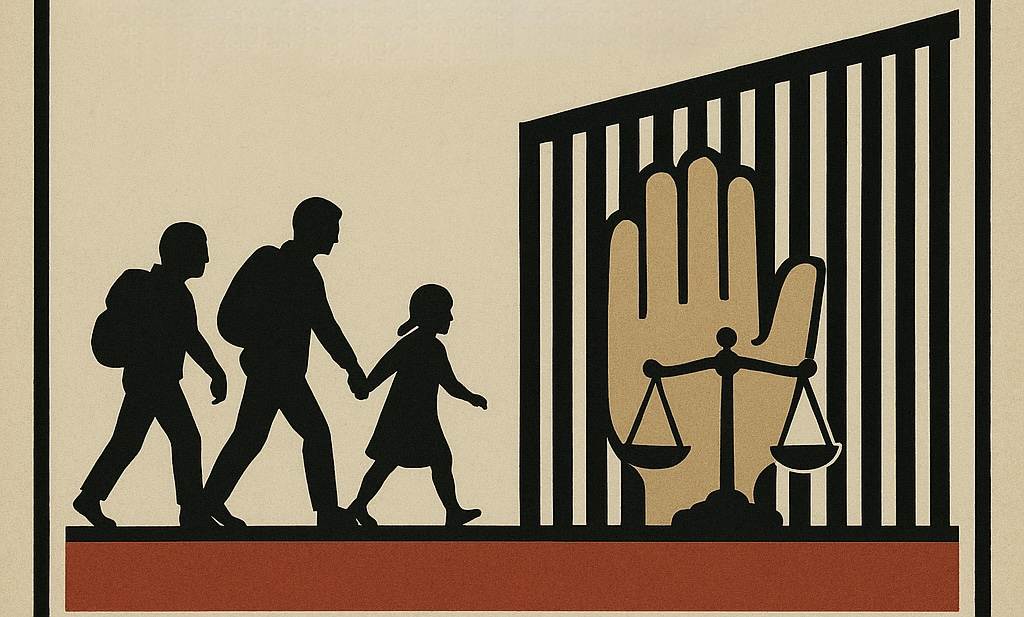
Diplomacy as a Tool of Concealment or a Pretext for Power?
Diplomacy, as applied in the case of the U.S.-Mexico border, does not function as a guarantor
of rights but as a mechanism for reproducing power and repression. Bilateral agreements
are presented as “cooperation,” but in practice shift the responsibility for violations onto
weaker states. Mexico, for example, now bears the burden of migration flows as a “barrier”
for the U.S.—effectively becoming a proxy border state.
The obsession with border control, rather than addressing the root causes of migration
(poverty, violence, environmental destruction, corruption), leads to the systematic
punishment of victims. And when diplomacy assumes the role of bystander—or
accomplice—the legitimization of violations becomes dangerously “normal.”
Diplomacy is not neutral—it is either a bearer of peace or a tool for concealing crimes. U.S.-
Mexico bilateral agreements have repeatedly sacrificed human rights on the altar of security
and political expediency. And as long as the international community chooses to remain
indifferent, the cost will be borne by the most vulnerable: the migrants. Addressing this
phenomenon requires not only political will, but also a redefinition of diplomacy as a
responsible and human-centered practice—and not as a mask for hypocrisy.
Sources:
https://www.hrw.org/report/2024/05/01/we-couldnt-wait/digital-metering-us-mexico-border?